
Failing Danish: Language Learning as a Model for Growth
A personal testament to how language learning changed my life

In November 2022, I had the privilege of failing my beginner’s Danish test. Once the initial shock and disappointment subsided, it’s no exaggeration to say that my life started to take a completely different direction, and entirely for the better. That failure allowed me to discover a way of learning, developing and improving by constantly putting myself out there and embracing failure. What started as a philosophy for language learning soon came to infect all areas of my life and result in an upwards spiral of personal, social and academic development.
Following my Danish failure, after a few days wallowing in self-pity and denial, I finally accepted that I needed to actually find a way to learn that worked for me. I spent a few months afterwards trying different things until I stumbled across Steve Kaufmann on YouTube. Here I was absolutely captivated by his story and videos professing the benefits of comprehensible input and his language learning website LingQ. This article is not intended to be an advertisement for LingQ, although I would happily write such an article. Whilst language learning itself has been a great source of joy and opportunity, this article aims to demonstrate how it’s served as a platform and model for countless other forms of growth.
The Process is the Reward
Bertrand Russell wisely said: “The more things a man is interested in, the more opportunities of happiness he has”. Steve Kaufmann and LingQ gave me a mindset and platform to enable this through languages. By surrounding myself with immersive content that I was actually interested in: Danish news, TV, podcasts and books I was able to use my Danish for what I actually wanted to use it for: learning more about this culture I was connected to, albeit at a distance, my whole life.
This had been my goal for years. To learn Danish so I could then use it to learn more about the culture and my semi-estranged family. The mindset shift I gained from Steve Kaufmann was that I could in fact do this, through the study of the language. While I couldn’t go from failing my beginners test to reading academic texts and books, I could engage with children and teenager content on Danish history, culture and politics. This would then build the conceptual and linguistic awareness of key terms, concepts and debates which would slowly be built upon until I was able to access the adult academic and social content I originally focused on.
The mindset shift from “I want X so I can then do Y” to “the process is the reward” was monumental. What started as an approach to language learning soon bled into many other aspects of my life. I started to realise and act in such a manner that the joy did not come from some idealised goal, like a mirage, constantly lingering in the horizon no matter how far we push forward, the joy was in fact the chase itself.
This was a lesson, I’m not unique in having learned countless times before in my life, but have consistently failed to apply it. This is perhaps best demonstrated by video games: we play a video game for the game, not the rewards. Once we finally beat that level, boss or get that rare item, we either: find another challenge to beat, or: use that new item for five minutes, log out and never play the game again. Why? Because there’s no reason to keep on playing, there’s no process, and the process is the reward.
I’m reminded by what Arnold Schwarzenegger said about winning. He still isn’t sure how many trophies and competitions he won in his career as he was so focused on the processes that enabled him to win, he didn’t care for the trophies, often giving them away. As soon as he won one trophy he was immediately focused on the next goal or competition. An insatiable desire for chasing processes (not titles) that no doubt played a role in his domination not just in bodybuilding but Hollywood and politics. After winning Mr Olympia 7 times, he easily could have easily retired on the fame and royalties, but he was addicted to the process of winning and achieving success, not the results of having achieved success.
After realising that the process is the reward, not just in languages, many things in life felt like cheating. Many of the things I’d always seen as negative conditioning factors such as rejection or failure, started to become positive in their own way.
Embracing Failure
Once the reward is understood to be the process itself, failure loses its intimidation and fear factor. As Steve Kaufmann said: “to speak with no mistakes, we must speak with mistakes” (paraphrased). As failure is the best, and sometimes, only way to learn in language learning, it becomes something to chase, not fear. Without failing, stumbling, mixing up my grammar and pronunciation while ordering that food, or asking for a receipt, I’ll never learn, and internalise, how to do it properly. Better yet, humans are emotional creatures, any lingering embarrassment from forgetting the word “fork” while ordering takeout food will just sharply increase the likelihood of you remembering that word and avoid that same mistake in the future.
What was feared and avoided as “failure” becomes a desired and chased outcome: a learning opportunity.
This was perhaps the most fundamental factor that led to wider personal growth. Discussions over politics or personal disagreements ceased to be fierce battles of defending my identity and pride, but opportunities to learn about another perspective and use this to enhance my own. I think we’ve all had heated arguments and suddenly realised that we’re wrong half way through, but pursued our case nonetheless as we’d put our pride on the line. For me, the mindset shift enabled by language learning made this type of self paradox largely disappear from my life. As the perception of “failure” had become something desirable (a learning opportunity), I found it not just easier to say sorry, accept my limitations and grow, but it became a genuinely attractive opportunity I actively sought out from friends, family and my academic mentors. Whilst I’m still prone to being an arrogant goit more often than I care to admit, language learning really catalysed my love for learning as opposed to having had learned.
The Upwards Spiral
I was fortunate enough to be raised with a strong emphasis on curiosity. Language learning allows me to constantly scratch this itch for learning, whilst meeting more people and bringing more opportunities for further growth and learning. This creates a positive feedback loop I like to call the “upwards spiral”.
Despite my mother’s English being flawless and our relationship always having been a close one, I found that learning her native language, and through it, plenty about her native culture, brought our relationship to the next level. Not just through an increased cultural understanding, but the moments we could share together increased greatly. Whether it was watching classic Danish Christmas shows together, singing Kim Larsen while cooking or discussing developments in Danish news and society, they each provided an opportunity to strengthen our relationship that was previously unavailable.
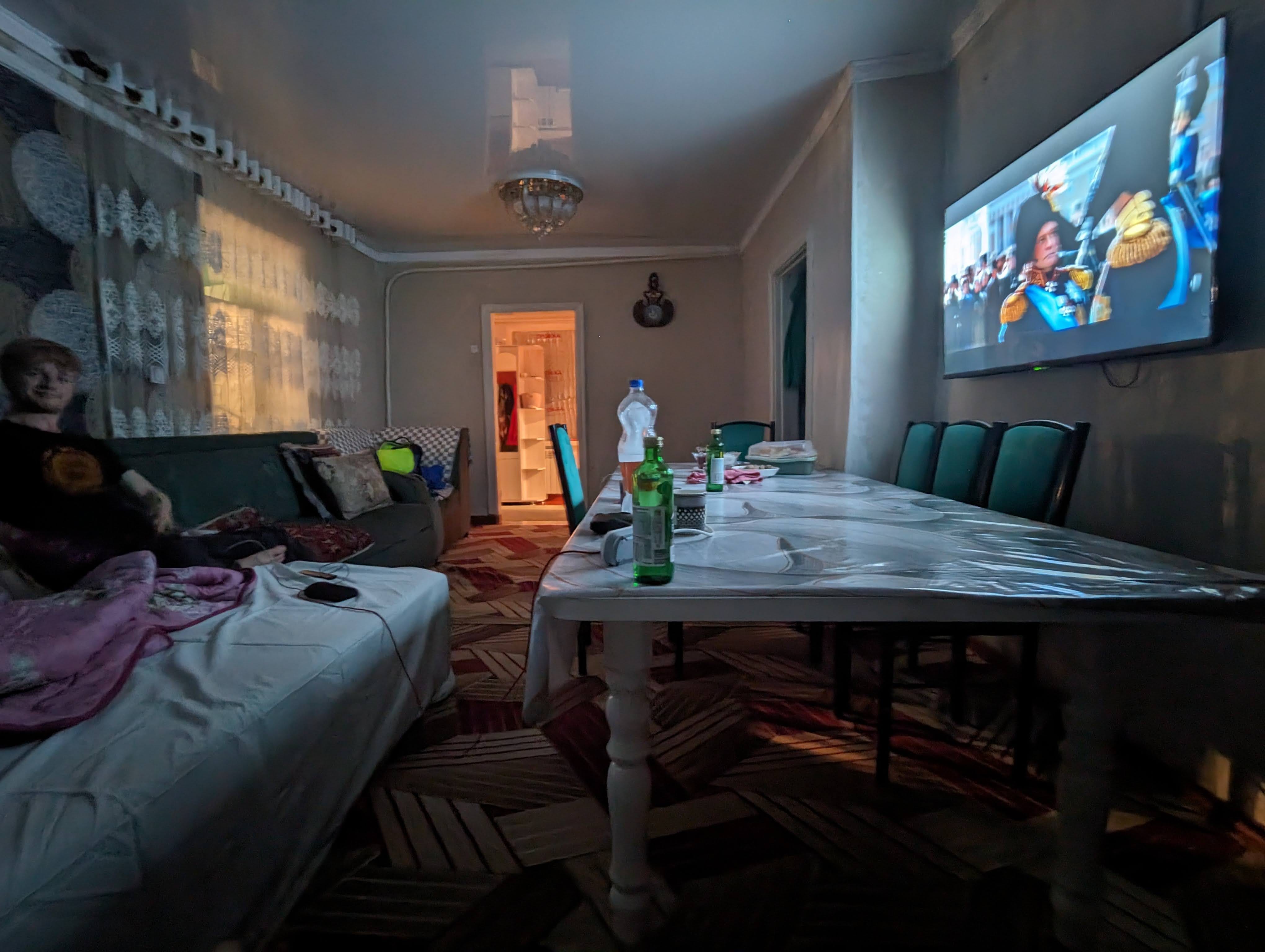
The benefits of language learning aren’t just limited to those already in our lives, but it opens up so many new doors. My Russian has allowed me to backpack around Central Asia and the Caucasus talking to conscripted soldiers from rural villages, bonding over our shared curiosities in each other’s culture. I’ve played cards with locals on old Soviet trains in the Uzbek desert, been invited to stay the night at Beka’s (One of our taxi drivers in Kyrgyzstan) house because of our shared love for late Soviet rock music and countless other opportunities
The benefits aren’t limited to social curiosities but are also professional. I’ve used Russian, Spanish and a smidgen of Arabic as an English teacher to build the respect that’s essential to an effective student-teacher relationship. Showing students the importance of communication over perfectionism by explaining the occasional concept in their own language does wonders in the classroom. It puts us on more equal footing. I’m no longer a scary native speaker judging their defilement of my beautiful language, but a fellow learner, prone to mistakes but still prioritising communication and connection above all.
Is Neuroplasticity contagious?
Whilst I’m a complete amateur on neuroscience, and my opinions on such matters hold less weight than an anaemic packing mule, I do have this nagging belief that the neuroplasticity promoted by language learning is contagious and offers a “rideable momentum” of sorts. What I mean by this is that the real and documented phenomenon of language learning physically changing the brain is not just limited to enabling “language pathways”.
If nothing else, my personal story demonstrates that what started as growth in my language processing ability quickly spread to social and personal development. Countless people in my life have commented that since learning Danish my productivity, organisation, and confidence have skyrocketed. My grades skyrocketed from a low 2:1 to graduating with a first-class degree. I started to consistently plan my weeks, exercise daily, cook weekly portions of healthy meals and studied intensely for 5+ hours a day. Without the mindset, structure and goal orientation of language learning, I would have stayed a curious and passionate yet highly disorganised and anxious individual.
Concluding remarks
To conclude, while I was fortunate enough to be raised in a culture and climate that valued curiosity, language learning gave me the long missing key to execute and explore this curiosity. It has allowed me to learn about and travel across the world, literally on my university holidays on trips across the Caucasus, Central Asia and Arab World and figuratively through the masses of previously inaccessible literature, news, culture and science I have been able to access through the internet. And this, for me at least, has been one of the main reasons for an intense feeling of deep happiness and personal contentment these past three years. If, as Russell suggests, “The more things a man is interested in, the more opportunities of happiness he has”, then languages open up countless new worlds of “things”: people, places, philosophy, history, relationships, but most of all: possibility.
very insightful piece! thank you for sharing your experiences! "the joy was in fact the chase itself." what true words. It's a very liberating realization. It gives away the pressure of having to obtain a goal. the paradox in my opinion is that you need to have a goal in order to be able to chase it, but at the same time realize that it's not really about the goal itself but rather the process of getting there...you need the goal (or at least some poeple do) to get into the process of acting and seeing the vision but the process of it is much mure important. what's the point of obtaining something if you don't enjoy the process of getting there?
languages really do open up new worlds, also within yourself. there is interesting research in psychology that suggests that our personalities are quite dependent from the language we are currently speaking.